Akaka Falls: The 442-Foot Plunge on Hawaii's Hamakua Coast

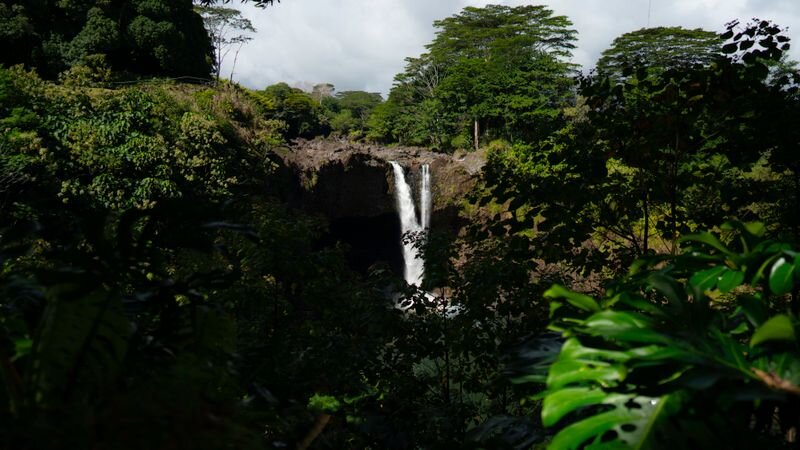
Akaka Falls doesn't trickle. It falls. The water drops 442 feet — taller than a 40-story building — in a single, unbroken plunge from a notch in the basalt cliff into a pool below, hidden in the deep-cut ravine of Kolekole Stream on the Big Island's Hamakua Coast. Mist rises from the base of the falls and hangs in the surrounding jungle, kept permanently wet by the waterfall's constant spray and the Hamakua Coast's extraordinary rainfall.
The Hamakua Coast receives more rainfall than almost anywhere in Hawaii. The trade winds hit the windward slopes of Mauna Kea and Mauna Loa and are forced upward, cooling rapidly and dropping their moisture as they rise. The upper Hamakua plateau can receive over 200 inches of rain annually. That water runs downslope through basalt carved by millions of years of erosion, and some of it reaches the coast through deep gulches and waterfalls like Akaka.
What makes Akaka Falls remarkable — beyond its height — is its accessibility. The falls are reachable in about 20 minutes on a paved 0.4-mile loop trail through tropical rainforest. This is not a backcountry experience. The path passes through stands of wild orchids, giant ferns, bamboo groves, and flowering ginger before arriving at the overlook. The falls are right there, framed by jungle on both sides, 30 feet away across the ravine.
Akaka Falls State Park: Two Waterfalls for the Price of One
Akaka Falls State Park contains two major waterfalls. Before reaching the main falls, the loop trail passes Kahuna Falls — a 100-foot cascade with a broader, veil-like shape that would be a standout attraction in most other parks. Here it's the supporting act. The contrast between Kahuna's wide curtain and Akaka's narrow, plunging column makes the loop more interesting than a single-destination walk.
The trail is paved throughout and has gentle slopes and some steps. It is suitable for most visitors including families with young children and older adults, though the surface can be slippery when wet (which is most of the time — bring shoes with grip). The park charges an entrance and parking fee. Hours are typically 8:30 a.m. to 6 p.m. daily.
The Name: What Akaka Means
The word ʻakaka in Hawaiian is generally translated as "crack," "split," or "separation." The name fits the landscape — the falls pour through a crack in the basalt that the stream has been widening for thousands of years, and the ravine itself is a deep, narrow split in the coastal plateau. Some sources suggest the name also carries connotations of clarity or revelation. Either reading fits a waterfall that drops dramatically through a crack in the earth and vanishes into mist below.
The Hamakua Coast: More Than One Waterfall
Akaka Falls is the most accessible and most famous waterfall on the Hamakua Coast, but the coast has dozens more. The old Māmalahoa Highway (the pre-1940s route that predates the current Highway 19) winds through a series of stream gulches, each with its own waterfall or cascade visible from the road or a short walk. The road passes through the Hamakua Heritage Corridor, which includes historic plantation towns, lush pasturelands, and some of the most dramatic coastal scenery on the Big Island.
Rainbow Falls in Hilo is about 15 miles south — an 80-foot waterfall that forms a rainbow in its mist on sunny mornings. Wailuku River State Park, which encompasses Rainbow Falls, also includes the Boiling Pots (a series of pools and cascades just upriver). A Hilo/Hamakua day trip that includes both Rainbow Falls and Akaka Falls is one of the best ways to see the rainy, verdant side of the Big Island.
Plan ahead: Akaka Falls State Park requires an advance parking reservation during peak hours (book via ParkMobile, zone 808030). Cell service is limited near the park — pay or book before you arrive. Morning visits give the best light on the falls. The Hamakua Coast town of Honomu, about a mile before the park entrance, has small cafes and a few shops — worth a quick stop.
Visiting as Part of a Hilo Day
Akaka Falls is easiest to visit as part of a Hilo-centered day on the Big Island. From Hilo, the drive to Akaka Falls State Park is about 15 miles north on Highway 19, then a short turn up Akaka Falls Road through Honomu. Combine it with Rainbow Falls and the Boiling Pots in Hilo, a stop at the Hilo Farmers Market (Wednesday and Saturday), and a walk through downtown Hilo's 1920s and 1930s commercial buildings along Kamehameha Avenue. Hilo is the rainy side of the island — most visitors stay on the dry Kona side and drive east as a day trip.
See Hawaii's Waterfalls
Guided waterfall tours on the Big Island and Maui cover Akaka Falls, Rainbow Falls, and the hidden cascades of the Hamakua and Hana coasts.
Hawaii Waterfall Tours →Frequently Asked Questions
How tall is Akaka Falls?
Akaka Falls drops 442 feet (135 meters) in a single, free-falling plunge — taller than a 40-story building. It flows year-round, fed by Kolekole Stream. The park also contains 100-foot Kahuna Falls on the same loop trail.
How hard is the Akaka Falls hike?
Very easy — a paved 0.4-mile loop through tropical rainforest, taking about 20 to 30 minutes. Suitable for all ages and fitness levels, including families with young children. The path can be slippery when wet, so wear shoes with grip.
Where is Akaka Falls State Park?
On the Big Island's Hamakua Coast, about 15 miles north of Hilo off Highway 19 via Honomu and Akaka Falls Road (Highway 220). A parking reservation via ParkMobile (zone 808030) is recommended during peak hours. The park is open daily approximately 8:30 a.m. to 6 p.m.