Punaluʻu: The Black Sand Beach Where Sea Turtles Sleep
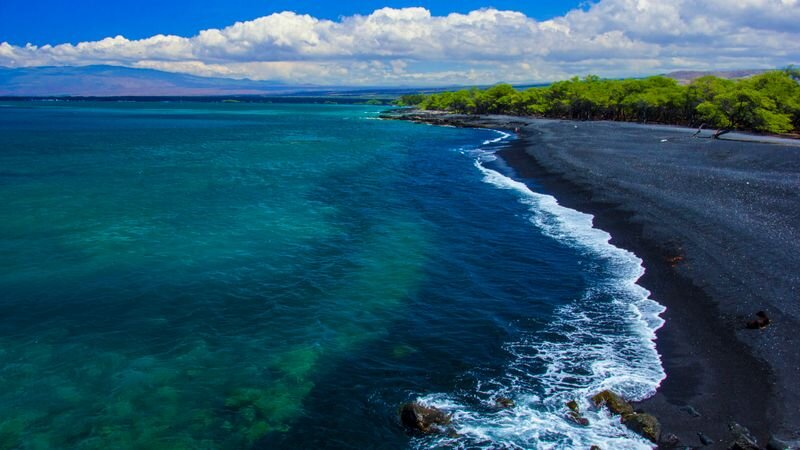
Most beaches in Hawaii are white, gold, or red. Punaluʻu is jet black. The sand at Punaluʻu Beach in the Ka'ū district of the Big Island is made of basalt — pulverized volcanic rock from the same lava flows that built this island over hundreds of thousands of years. Where most beaches form from eroded coral or continental minerals carried to shore over geological time, Punaluʻu's sand came from lava meeting the sea, cooling in an instant, and shattering into glittering black grains.
The beach is famous for the sand. But the reason most visitors make the drive here — down Highway 11 through the coffee farms and macadamia nut orchards of the Ka'ū district — is the turtles. Punaluʻu is one of the most reliable places in the Hawaiian Islands to see Hawaiian green sea turtles, known in Hawaiian as honu, hauled out on the beach and sleeping in the sun. On most mornings, a dozen or more turtles can be found resting on the black sand near the waterline, motionless, dreaming of whatever sea turtles dream of.
How Black Sand Forms
Black sand beaches in Hawaii form when lava flows reach the ocean. Hot basaltic lava at roughly 1,800°F hits cold seawater and the thermal shock causes it to shatter — an explosive process called hyaloclastite fragmentation. The result is a spray of tiny volcanic glass and mineral particles that accumulate in the bay or cove where the lava enters the water. Over time, the particles are rounded by wave action and sorted by size, producing the smooth, fine black sand visible at Punaluʻu.
Black sand beaches are geologically young and dynamically unstable. They form quickly during active volcanic periods and can disappear just as quickly through erosion. Some Big Island black sand beaches that existed in the 20th century have been covered by new lava flows; others have eroded away. Punaluʻu is one of the more stable examples because the cove geometry provides some natural protection from erosive swells.
The sand at Punaluʻu gets extremely hot in direct sun — far hotter than white sand, which reflects sunlight rather than absorbing it. Avoid walking barefoot across dry Punaluʻu sand in midday sun. The sand at the water's edge, kept cool by wave wash, is more comfortable.
The Honu: Hawaiian Green Sea Turtles
Hawaiian green sea turtles — honu — are one of the largest sea turtle species, with adults reaching lengths of 3 to 4 feet and weights of 200 to 400 pounds. They are not actually green on the outside; the name comes from the greenish color of their body fat, which comes from their algae-heavy diet. Their shells and skin are dark brown, gray, or olive.
Honu are long-lived — they can live 80 years or more — and slow-maturing. Females don't reach sexual maturity until roughly 25 to 35 years of age. They nest on beaches, but they also haul out to rest — a behavior unusual among sea turtles, more common in the Hawaiian population than in most other populations worldwide. Scientists believe it may be a strategy for regulating body temperature (basking in the sun) or simply efficient resting without the energy cost of treading water.
Punaluʻu's warm, south-facing black sand beach, sheltered from the trade winds by the coast's orientation, is ideal for this. Turtles have been hauling out at Punaluʻu for as long as anyone can document. The beach is one of a handful of known haul-out sites on the Big Island and is considered a critical resting habitat for the population.
Wildlife rule: Hawaiian law and federal law require that you stay at least 10 feet from resting sea turtles. Do not touch, feed, or approach them. Disturbing a resting turtle causes it to flee to the water — burning energy it needs for rest and thermoregulation. If a turtle is approaching you, move away from it. The turtles at Punaluʻu are accustomed to human presence but they are wild animals and deserve space.
Honu in Hawaiian Culture
The honu holds deep significance in Hawaiian tradition. In some families, turtles are considered ʻaumākua — ancestral guardians, spiritual protectors who take animal form to watch over their descendants. Harming a honu was traditionally a serious transgression. The cultural reverence for turtles is one reason Hawaiian green sea turtles may have fared better historically in Hawaiian waters than in many other parts of the Pacific.
The Hawaiian name for the green sea turtle, honu, is ancient — appearing in oral tradition, place names, and petroglyphs carved into lava across the islands. Turtle petroglyphs are found near several ancient habitation sites on the Big Island, including near Punaluʻu, suggesting that the relationship between the local community and these animals goes back centuries.
The Beach Today: What to Expect
Punaluʻu Beach Park is easily accessible off Highway 11, with parking, restrooms, and shaded pavilions. The beach is a moderate crescent of black sand, maybe 200 yards long, backed by coconut palms. The water is not particularly calm — wave action can be significant, and the beach has no lifeguard. Most visitors come to see the turtles and the sand, not to swim, though the snorkeling inside the bay is decent when conditions are calm.
The best time to see turtles is in the morning, before the beach fills with visitors and the heat builds. Turtles are most reliably present on the right side of the beach (east end), where the sand is broader and the wave wash is gentler. Count on spending an hour at Punaluʻu — it is a natural stopping point on any south Big Island circuit between Volcano Village and South Point.
See Hawaii's Sea Turtles
Snorkeling tours on the Big Island regularly encounter honu underwater as well as on the beach. Find tours with live availability and sea turtle sighting guarantees.
Sea Turtles & Marine Life Guide →Frequently Asked Questions
Why is Punaluʻu Beach black?
The black sand formed when molten lava entered the ocean and shattered on contact with cold seawater. The rapid cooling and fragmentation of basaltic lava produced black glass and mineral particles that accumulated on the shore. The beach continues to be replenished by volcanic activity on the island.
Can you see sea turtles at Punaluʻu Beach?
Yes — Punaluʻu is one of the most reliable turtle viewing spots in Hawaii. Honu (Hawaiian green sea turtles) regularly haul out to rest on the black sand, especially in the morning. Stay at least 10 feet away and do not touch, feed, or approach them — it is required by law and important for the turtles' wellbeing.
Where is Punaluʻu Black Sand Beach?
In the Ka'ū district of the Big Island, off Highway 11, roughly 55 miles south of Hilo and about 50 miles southeast of Kona. It is a natural stop on any south Big Island itinerary between Volcano Village and South Point.