Nuʻuanu Pali: The Cliff Where Kamehameha Won Hawaii
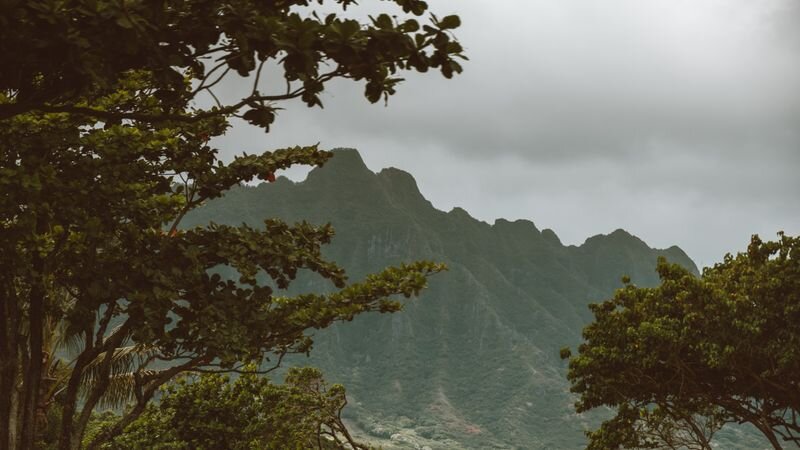
The wind at the Nuʻuanu Pali Lookout can knock you sideways. Trade winds funnel through this gap in the Ko'olau Mountains with such force that the National Park Service has installed railings to keep visitors upright. Standing there — with the windward coast of Oahu spread 1,000 feet below you and the air pressing hard against your chest — it is easy to understand how this place became a turning point in Hawaiian history.
In May 1795, King Kamehameha I drove the defending Oahu army up the narrowing Nuʻuanu Valley until they had nowhere left to go but over the edge. More than 700 warriors fell or were pushed from the pali. The Hawaiian name for the battle, Kalelekaʻanae — "the leaping mullet" — describes the image of men driven over a cliff the way schooling fish break from the water.
When construction workers built the Pali Highway in 1898, they found approximately 800 human skulls at the base of the cliffs. The battle that had been told for generations through oral history was confirmed in bone.
The Battle of Nuʻuanu, 1795
By 1795, Kamehameha I had already conquered the Big Island and Maui. Oahu was the prize that would complete the unification of the main Hawaiian Islands. He landed a force estimated at around 12,000 warriors — equipped with traditional weapons and, crucially, Western cannons and muskets. His army had been trained in their use by John Young, a British sailor who had become one of Kamehameha's most trusted advisors.
The Oahu forces, led by Chief Kalanikūpule, retreated progressively up the Nuʻuanu Valley as Kamehameha's army advanced. The valley narrows as it climbs. By the time the defenders reached the cliffs at the top, they were pinned — the Ko'olau range on both sides, Kamehameha's forces pushing from behind, and a near-vertical drop of roughly 1,000 feet in front of them.
The Oahu army's last stand collapsed. Hundreds were driven over the edge. Chief Kalanikūpule escaped temporarily but was captured later and sacrificed to the war god Kūkāʻilimoku. The battle unified Oahu under Kamehameha's control. Combined with his earlier conquests, it effectively created the Kingdom of Hawaii — a single political entity that would endure until the overthrow of 1893.
The Pali: A Gap in the Ko'olau Mountains
The Nuʻuanu Pali is not just historically significant — it is one of the most dramatic geographic features on Oahu. The Ko'olau Range forms the windward spine of the island, and the Nuʻuanu Valley is the natural breach in that range closest to Honolulu. For centuries, it was one of the only overland routes between the leeward (Honolulu) side and the windward (Kaneohe) side of the island.
The current Pali Highway, completed in 1957, runs through tunnels blored through the Ko'olau summit. The old road that climbed to the lookout — now the Nuʻuanu Pali Drive — predates it and still winds through dense jungle to the state wayside park at the top.
From the lookout, on clear days, you can see the entire windward coast: Kaneohe Bay, the Mokulua Islands, the flat green cane fields of the north shore, and the deep blue of the Pacific beyond. It is one of the best views on the island — and on stormy days, when clouds pour through the gap and the wind howls, it is one of the most elemental.
Visit tip: Hold onto your hat — literally. Wind at the lookout regularly exceeds 50 mph. Keep a firm grip on loose items. The park is free to visit and accessible year-round. Combine it with the drive along the Ko'olau foothills or a stop at the Byodo-In Temple in nearby Kaneohe.
The Legend: Don't Bring Pork Over the Pali
Hawaiian oral tradition holds that the pali is a portal between the world of the living and the spirit world — particularly at night. Night Marchers, the ghostly procession of ancient warriors called huakaʻi pō, are said to travel the old trails through the Nuʻuanu Valley. One of Oahu's most persistent folk legends warns that you should never carry pork over the Pali Highway after dark, as it will anger the spirit of Kamapuaʻa, the pig demigod, whose territory this was.
Many locals still observe this. The legend is old enough and consistent enough that it gets passed down through generations regardless of belief. Whether or not you observe it, the story is a reminder that this landscape has layers of meaning that predate the highway by centuries.
Visiting the Nuʻuanu Pali State Wayside
The Nuʻuanu Pali State Wayside is about 7 miles from downtown Honolulu via the Pali Highway (Route 61) or the older Nuʻuanu Pali Drive. The lookout is free to enter. Parking requires a small fee. The site is open daily during daylight hours.
The views are worth the drive from Waikiki — about 20 to 30 minutes depending on traffic. Most visitors spend 20 to 30 minutes at the lookout itself. The Nuʻuanu Pali Drive offers a slower, more scenic approach through old-growth forest if you have time.
Explore Oahu Beyond Waikiki
Circle Island tours, Pearl Harbor, the North Shore, and the windward coast — see more of Oahu with a guided day tour.
Browse Oahu Tours →Frequently Asked Questions
What happened at Nuʻuanu Pali?
In May 1795, Kamehameha I's army pushed the defending Oahu forces up the Nuʻuanu Valley until they were trapped at the cliff edge. More than 700 warriors fell from the approximately 1,000-foot pali. The battle effectively unified the main Hawaiian Islands under Kamehameha's rule. Construction workers building the Pali Highway in 1898 found around 800 skulls at the base, confirming the oral tradition.
Why is it so windy at the Nuʻuanu Pali Lookout?
The pali is a gap in the Ko'olau Range where northeast trade winds funnel through from the windward coast. The narrow valley compresses the airflow, dramatically increasing wind speed at the lookout. Winds regularly exceed 50 mph.
What does "pali" mean in Hawaiian?
"Pali" means cliff. Nuʻuanu Pali roughly translates to "cool height cliff."