Kīlauea & Pele: The Legend of the World's Most Active Volcano
Kīlauea's name means "spewing" or "much spreading" in Hawaiian — a name that has proven accurate for centuries. The volcano, sitting on the southeastern flank of Mauna Loa on Hawaii's Big Island, has been erupting almost continuously since 1983. From that year until 2018, a single eruptive sequence ran without meaningful interruption for 35 years — one of the longest sustained eruptions ever recorded on Earth. By the time that eruption ended with catastrophic summit collapse and lava intrusion into lower Puna, it had added roughly 875 acres of new land to the Big Island and destroyed more than 700 homes.
For Native Hawaiians, Kīlauea is not primarily a geological phenomenon. It is the home of Pele — Pelehonuamea, the goddess of volcanoes, fire, and lightning. Her abode is the Halemaʻumaʻu crater, the active vent within Kīlauea's summit caldera. When the volcano erupts, she is present. When lava flows destroy homes and devour land, it is her movement across her domain. The name for her in one of her most powerful manifestations is ka wahine ʻai honua — "the woman who devours the land."
The Geology: A Volcano Built on a Hotspot
Unlike most volcanoes on Earth, which form at the boundaries between tectonic plates, the Hawaiian volcanoes are the product of a stationary hotspot — a plume of superheated mantle material rising through the Pacific Plate from deep below. As the Pacific Plate moves northwest at roughly 3 to 4 inches per year, new volcanic islands form over the hotspot and then drift away from it, going dormant and eventually eroding into atolls. The Big Island of Hawaii is the youngest landmass in the chain, currently over the hotspot, and its volcanoes are therefore the most active.
Kīlauea sits on the southeastern slope of Mauna Loa, which is itself one of the largest shield volcanoes on Earth. Kīlauea is 4,010 feet tall at its summit — relatively modest compared to Mauna Loa or Mauna Kea — but it is extraordinarily active. Scientists estimate it has been erupting in some form for about 300,000 years, with periodic major activity over the last 2,500 years covering more than 500 square miles of the Big Island's southeastern surface in lava.
Halemaʻumaʻu: The Crater Within a Crater
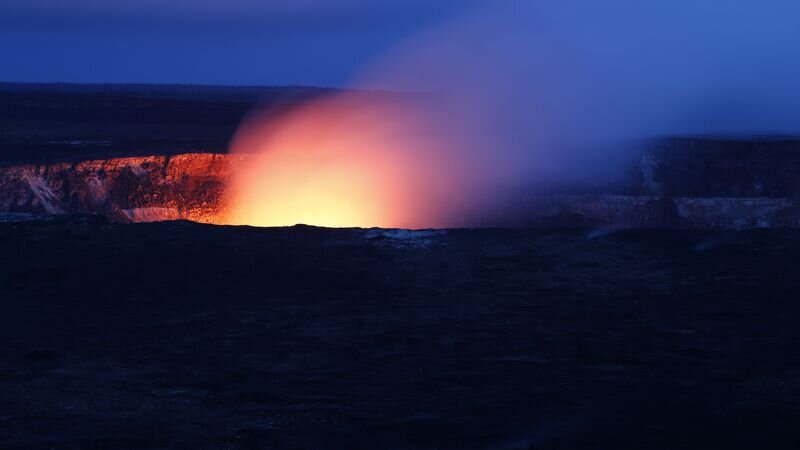
Kīlauea's summit caldera is roughly 2.5 miles long by 2 miles wide — a broad depression formed by past collapses of the volcanic summit. Within that caldera sits Halemaʻumaʻu, a smaller but more active vent that has historically contained a lava lake. The Halemaʻumaʻu vent is where Pele is said to dwell.
In 2008, a new lava lake formed within Halemaʻumaʻu — the first sustained lava lake there in nearly a century. Visitors could watch its glow from the Jaggar Museum overlook at night. In 2018, the entire summit region collapsed catastrophically during the lower East Rift Zone eruption: the floor of the caldera dropped hundreds of feet, Halemaʻumaʻu grew dramatically as material fell in, and the lava lake drained. The reshaping of the summit was a massive geological event visible from space.
A new lava lake formed inside the rebuilt Halemaʻumaʻu in December 2020, and eruptions have continued intermittently through 2024 and 2026. The summit landscape continues to evolve.
Visit tip: Check the USGS Hawaiian Volcano Observatory website (volcanoes.usgs.gov) for current eruption status before visiting. Activity changes on timescales of days to weeks. Hawaiʻi Volcanoes National Park is open 24 hours — nighttime visits during active eruption phases can be extraordinary. The park entrance fee covers multi-day access.
Pele: The Fire Goddess and Her Stories
In Hawaiian tradition, Pele did not always live at Kīlauea. She originated from Kahiki (a name used in Hawaiian oral tradition to refer to a distant homeland, possibly Tahiti or another Polynesian island) and traveled through the Hawaiian island chain, digging fire pits with her pō-oʻo stick, searching for a home. Each island she dug was flooded by her sister Nāmaka, the goddess of water and the sea, and she was forced to move on.
She tried the pits at Kauaʻi, Oʻahu, Molokaʻi, Maui — each one eventually extinguished by Nāmaka's waves. Finally she came to the Big Island, where Halemaʻumaʻu at Kīlauea's summit was deep enough and hot enough that Nāmaka's waters could not reach it. There she settled. The island chain's geology — older, deeply eroded volcanic islands to the northwest, the younger and more active Big Island to the southeast — mirrors the progression of Pele's journey through the chain.
Pele stories are active oral tradition, not historical myth. Residents of the lower Puna district, where lava has repeatedly destroyed neighborhoods, speak of Pele with respect and sometimes grief, not as metaphor but as a real presence. The 2018 eruption that destroyed Leilani Estates produced lava fountains hundreds of feet tall and sent rivers of lava to the sea. For many in the community, this was not a geological event with a mythological gloss — it was Pele, moving through her land.
The Park: Visiting Kīlauea Today
Hawaiʻi Volcanoes National Park encompasses Kīlauea and portions of Mauna Loa's slopes. The park's Crater Rim Drive circles the summit caldera, passing overlooks of Halemaʻumaʻu and the caldera floor. The Chain of Craters Road descends from the summit to the coast, passing dozens of smaller craters and lava flows from past eruptions, ending where 1990s lava covered the highway.
The Thurston Lava Tube (Nāhuku) is a short, paved walk through a 500-year-old lava tube — a tunnel formed when the surface of a lava flow hardened while molten lava continued flowing through the interior. The park also includes the Kilauea Iki Crater, where a 1959 eruption created a lake of lava that is now a solid but still-hot floor you can hike across on a designated trail.
The park was designated a UNESCO World Heritage Site in 1987. It is one of the most visited national parks in the United States.
Explore Kīlauea on a Volcano Tour
Guided volcano tours from Kona and Hilo cover Hawaiʻi Volcanoes National Park, lava viewing (when active), and the Big Island's extraordinary geological landscape.
See Big Island Volcano Tours →Frequently Asked Questions
Is Kīlauea the world's most active volcano?
Yes — widely considered so. From 1983 to 2018 it maintained a nearly continuous 35-year eruption. It erupted three separate times in 2024 alone. Activity continues intermittently into 2026. The USGS updates current status daily.
Who is Pele in Hawaiian mythology?
Pele is the Hawaiian goddess of volcanoes, fire, and lightning. Her home is the Halemaʻumaʻu crater at Kīlauea's summit. She is known as "the woman who devours the land" and "she who shapes the sacred land." In Hawaiian tradition, volcanic eruptions are her physical presence — not metaphor.
Can you see lava at Kīlauea?
Lava visibility depends on current activity, which changes frequently. Check the USGS Hawaiian Volcano Observatory (volcanoes.usgs.gov) for daily updates. The park is open 24 hours — nighttime visits during active eruption phases are extraordinary.